

The type of soccer cleats you wear can make or break your performance. All things considered, this is the one piece of sport equipment that will affect your game the most. In fact, if you strip down to nothing but your cleats, you’ll become more aerodynamic and perform at your best! (Not recommended though). However, that’s beside the point. Cleats protect your feet, provide traction on grass, and give you the support/stability you’ll need to dart across the field. Thus, it’s important to figure out what kind of cleats will suit you best. Knowing the anatomy, the different types of soles, material, features, and proper fit will enable you to make that decision. With that said, here’s our guide on how to choose soccer cleats.
How to Choose Soccer Cleats Infographic
Share This Guide On Your Site
How to Choose Soccer Cleats: In-Depth
Step 1: Discover the Anatomy


- Lining - The sock-like fabric on the inside of the shoe, improves comfort
- Eyelets - Holes in the upper help to keep the laces in place
- Lacing - Soccer cleats use traditional laces allowing for the most adjustment in fit
- Toe box - A flexible toe box allows for efficient running and dynamic movements
- Vamp - Covers the forepart of the cleat, provides excellent feel
- Upper - Thin, lightweight material such as leather, kangaroo leather, or synthetics is often used for a better feel
- Heel panel - The piece of fabric covering the heel
- Tongue - A thin tongue with minimal padding helps to improve feel
- Insole - The footbed of the cleat, provides comfort and support
- Last - Underneath the insole lies the last, which determines the shape of the cleat
- Midsole - The cushioning in-between the insole and outsole, thin which allows you to feel the ground more
- Heel cup - A snug heel cup helps to lock down the heel
- Heel counter - The rigid plastic insert behind the shoe that keeps the structural integrity of the heel
- Collar - A padded collar helps to improve comfort and fit
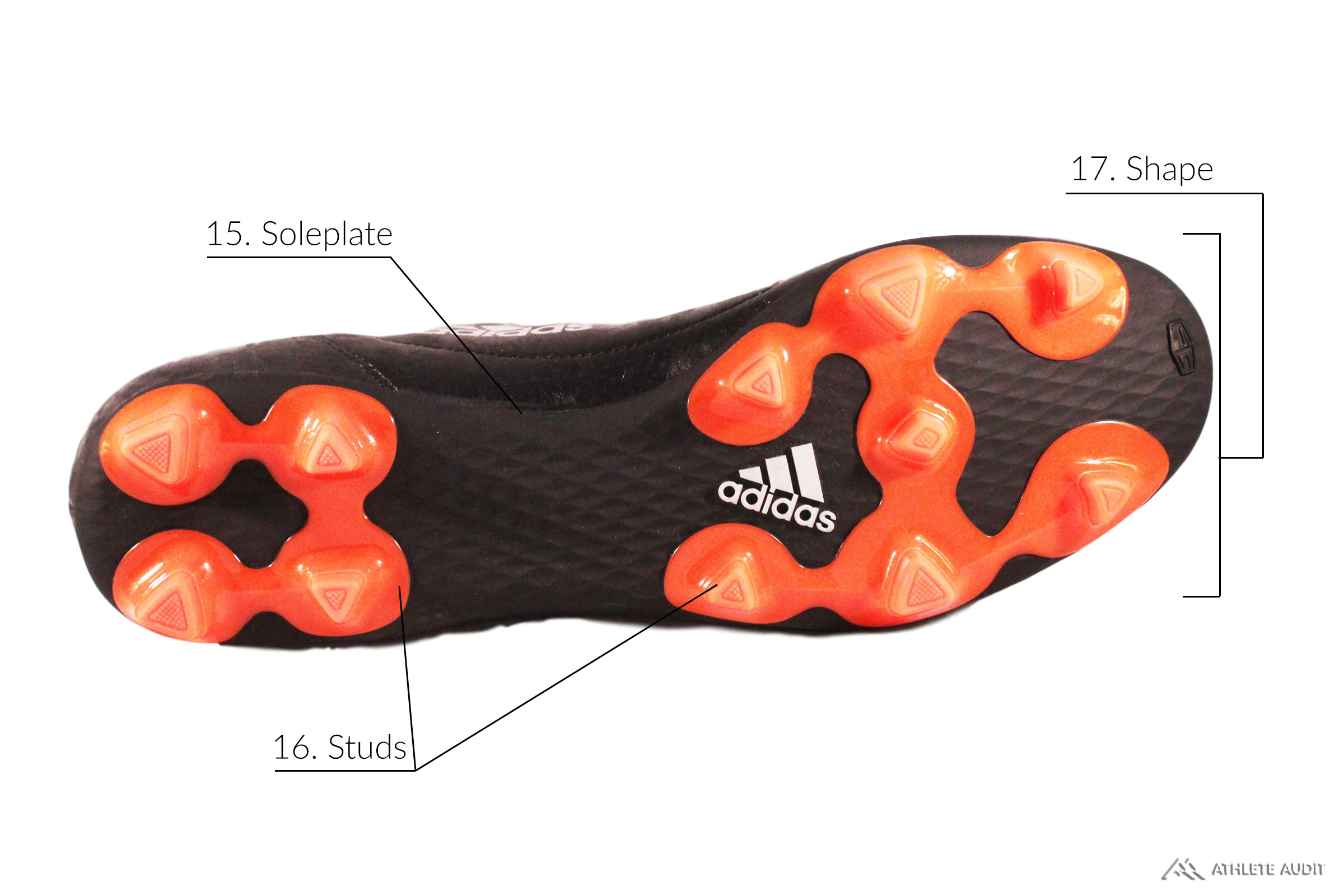
- Soleplate - A stiff, lightweight soleplate houses the studs
- Studs - Often made of molded plastic, provides traction on soccer fields
- Shape - Determined by the last, the shape of a cleat will affect the fit in the heel, arch, and forefoot
Step 2: Pick the Best Type of Sole
The type of ground you are going to play on will determine the type of outsole you’ll need. There are three types to choose from: firm ground, soft ground, or artificial ground.
Firm Ground (FG)
Best On: Most firm natural surfaces where it doesn’t rain often
Firm ground cleats use molded studs that are either conical or blade shaped and evenly distributed throughout the bottom of the shoe. They provide sufficient traction for most pitches, making them very popular and versatile. Conical studs are rounded at the bottom and give players more flexibility of motion. Blade shaped studs are thinner like… blades and provide better traction, although not as much mobility as cone shaped studs. Since firm ground cleats are so versatile for most playing conditions, they are also the safest shoes to buy if you’re not sure what type of pitch you’ll be playing on.
Soft Ground (SG)
Best On: Soft or wet natural surfaces such as mud
Perfect for soft or wet natural surfaces (e.g. mud, where it rains often), soft ground cleats offer more traction than firm ground cleats. The studs found on soft ground cleats are very similar to firm ground ones, although there are usually fewer of them (~6) but more optimally placed. Studs can also be conical or blade shaped and there are often two in the bade on either side of the heel and four along the front of the shoe. Soft ground cleats should only be used on soft surfaces, or else pain and injury could occur.
Artificial Ground (AG)
Best On: Artificial grass
Artificial ground cleats feature lots of shorter, low-profile studs than firm ground cleats. They aren’t made to dig into the ground but provide excellent grip on solid surfaces. Thus, they shine on fields such as artificial grass or where most of the grass is worn down to leave much of the hard surface exposed.

Step 3: Know Your Material
Material is also a necessary aspect to talk about when learning how to choose soccer cleats. Different materials have different fits and performance and so, many soccer players have a preference when it comes to material. Upper materials usually boil down to two types: leather and synthetic.
Leather - Known for being flexible and soft, leathers are non-chafing and mold to your feet. Provides excellent touch although it also stretches after a few wears so fitting a shoe snug to very snug at first is your best bet at a perfect fit once it gets broken in. Most natural leathers also absorb water when playing on wet pitches.
Kangaroo leather - A premium leather that provides maximum comfort and ball feel. Molds to your feet and you won’t have to break them in. Very light and soft. Not as durable or waterproof as calfskin or cowhide leather. Stretches after a few wears and the most expensive.
Calfskin leather - Less expensive than k-leather while also providing a similar feel with regards to softness, flexibility, and durability. Also provides great touch and water-resistance. Though it retains its shape better, it is also a little heavier than k-leather.
Full-grain leather - Thicker and more durable than both kangaroo and calfskin leather, full-grain leather offers water-resistance and a comfy fit/ball feel comparable to calfskin and k-leathers. However, it’s heavier than both.
Synthetic - Often lighter, thinner, and more durable, synthetics won’t stretch as much in damp conditions making them ideal for wet grass. The downsides are that they aren’t as comfortable, durable, or provide a great feel like real leathers.
Synthetic leather - Comparable to real leathers although it doesn’t stretch as much and sacrifices a little on feel. Many soccer cleat companies are improving on that however by applying features such as waterproofing or added friction in coatings and treatments.
Mesh - Remarkably thin and highly breathable, this lightweight material is also used on running shoes. However, the downsides include the fact that moisture can get in the shoe.

Step 4: Consider Additional Details
Weight
It seems the trend nowadays in soccer culture is lighter weight and thinner materials. This could be due to new materials and technologies used by shoe companies. Although this can compromise on durability, lighter cleats offer exceptional performance. Whereas the average weight of cleats about 5 years ago stood around 9.4 oz, it’s closer to 8 oz these days. In general, more weight means more durability but less performance, and vice versa for lighter cleats. With this in mind, it’s safe to say that 8 oz is a balanced weight, offering both good durability and performance. As we’ve explained, lighter cleats are ideal for players who favor explosive movements and lightning quick agility. Specifically, forwards and wingers benefit the most from lightweight shoes.
Breathability
Remember, a game of soccer takes approximately 90 minutes where you’ll be actively moving the entire time, so breathable shoes are a must if playing in dry weather/conditions. Lightweight materials such as mesh are thin and highly breathable, but don’t keep moisture out very well. Thinner leathers also help the feet stay cooler in hotter climates.
Budget
Be reasonable in how much you can spend on a pair of cleats. If you don’t play often, don’t purchase a very expensive pair. Now, if you’re always on the field, consider which is more important to you: durability or performance? If your goal is to find cleats that will last, look toward low to mid tier shoes. If performance is what you want, a mid to high tier pair will suit you best.
- Top-tier - $150 and up - Best of the best, cleats in this range offer the best performance but less than stellar durability. Recommended for competitive play.
- Mid-tier - $80 - $150 - Most popular option for most soccer players, as it provides good performance and great durability. Recommended for recreational and competitive play.
- Low-tier - $40 - $80 - May be lacking in performance but offers great value for players just starting out. Recommended for recreational play.
- Anything under $40 - Don’t even bother. With the quality of these types of shoes, you’d be looking at burning through several pairs before you can meet the durability and performance of even low-tier cleats.
Step 5: Find the Right Fit
Soccer is a very intense physical sport, so when learning how to choose soccer cleats, it’s crucial that you pipck cleats that you can wear for more than an hour at a time. You should also take into consideration your foot size and shape as you don’t want any pockets of empty space or shoes that are too tight in certain areas.
Signs of a Perfect Fit
- 1/8 to 1/4″ of space in the toe with a snug forefoot and heel that doesn’t lift
- Fits your foot’s volume and width. Note that volume and width are not the same thing
- No pain, discomfort, chafing, or pressure points
Tips for Fitting Soccer Cleats
- Consider whether material will stretch and size accordingly. Real leathers stretch, synthetics don’t
- Wear socks you intend to play with while trying on shoes
- Shop in-store and in the afternoon for the most accurate fit
- Try walking and running in shoes to ensure comfort. Any pain or discomfort will be felt even more on the field
- Consider adding your own insoles or orthotics for more comfort or a better fit
- Try multiple sizes of the same shoe to find the comfortable ones


